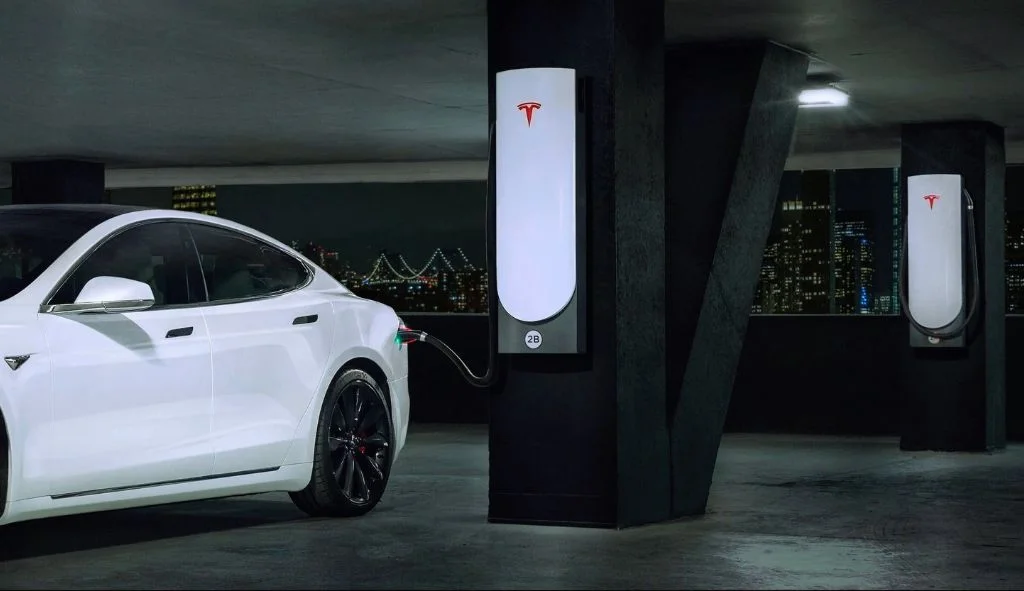
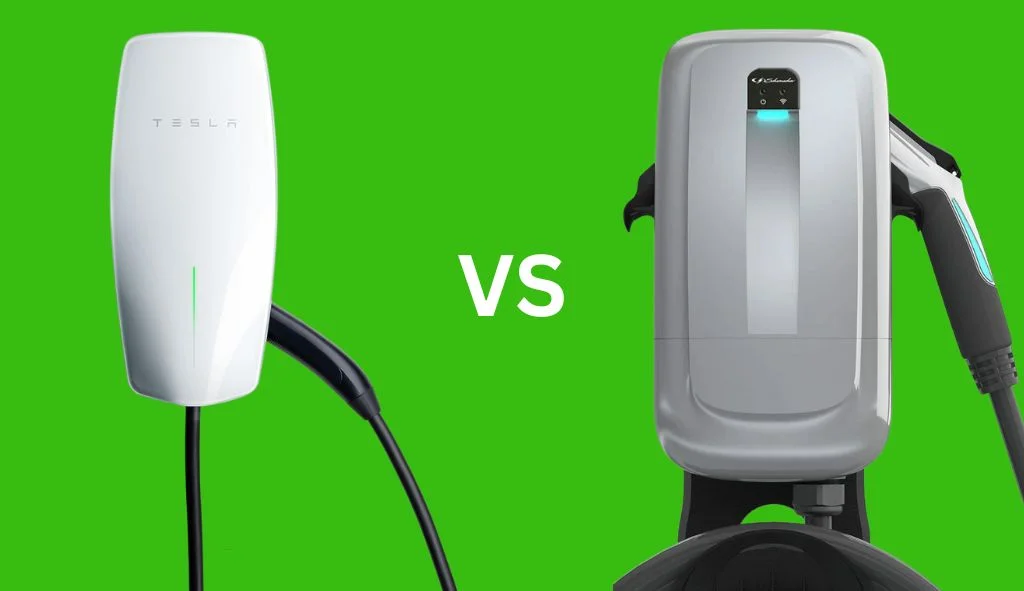
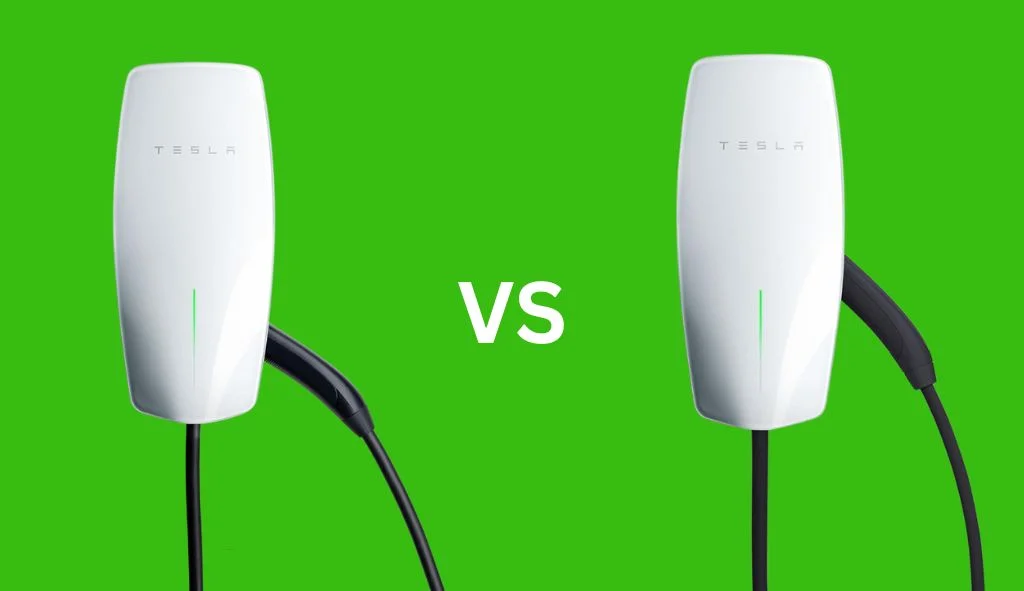
A Tesla wall charger, which Tesla calls the Wall Connector, is a hardwired 240 V unit that pushes up to 48 amps into the car, about 44 miles of range per hour on a Model 3 or Model Y, so a 40-mile day goes back in under an hour. Most owners need one only if they drive a lot, own a car with a 48 A onboard charger, or want the cleanest install in the garage.
Below: the four home charging options, which cars can use 48 A, and what the install involves.
What the Wall Connector is, and what it is not
Strictly speaking, the Wall Connector is not a charger. It is EVSE (electric vehicle supply equipment): a smart, safety-checked switch between your panel and the car. The actual AC-to-DC conversion happens in the car's onboard charger. The Wall Connector's job is to tell the car how much current the circuit can safely supply, close its contactor when the car asks for power, and shut off fast if something goes wrong. It has built-in ground-fault protection (a CCID20 device), so it does not need a GFCI breaker in the panel.
That split explains most of the confusion owners run into. A Wall Connector on a 60 A breaker can offer 48 A, but a car whose onboard charger tops out at 32 A will take 32 A and no more. The charger box sets the ceiling; the car sets the actual rate.
The current US unit is the Gen 3 Wall Connector (part number 1457768). It has a glass faceplate, a vertical light strip, a 24 ft cable, Wi-Fi, and a Tesla (NACS) handle with a button that opens the charge port. It weighs 10 lb including the wirebox and measures 13.6 x 6.1 x 4.3 in. It is hardwired only: the manual prohibits fitting it with a cord and plug.
Gen 3, Universal, Mobile Connector or a 14-50 outlet
There are four realistic ways to charge a Tesla at home on 240 V, and the right one depends far more on your car and your panel than on the price tag. Prices below are Tesla Shop list prices as of October 2026; all three Tesla units showed as out of stock on October 13, 2026.
| Option | Price (Oct 2026) | Max output | Range per hour (Model 3/Y) |
|---|---|---|---|
| Gen 3 Wall Connector | $585 | 48 A, 11.5 kW | up to 44 mi |
| Universal Wall Connector | $660 | 48 A, 11.5 kW | up to 44 mi |
| Mobile Connector on a NEMA 14-50 | $300 (14-50 adapter included) | 32 A, about 7.7 kW | up to 30 mi |
| Mobile Connector on a 120 V outlet | $300 | 12 A | 2 to 3 mi |
| Option | Install | Best for |
|---|---|---|
| Gen 3 Wall Connector | Hardwired, 60 A breaker for full speed | Teslas with a 48 A onboard charger, high mileage, two-Tesla homes |
| Universal Wall Connector | Same wiring as Gen 3 | Homes with a Tesla and a J1772 or NACS car from another brand |
| Mobile Connector on a NEMA 14-50 | 50 A outlet, GFCI rules apply | Base Model 3 and Model Y, renters, owners who want a portable unit |
| Mobile Connector on a 120 V outlet | None | Very low mileage or a stopgap |
Gen 3 Wall Connector. The default pick for most Tesla households. It is the only option that reaches 48 A, it supports power sharing between up to six units, and the handle stays on the wall instead of in a bag. If you are still deciding between it and an older unit you found secondhand, our Gen 2 vs Gen 3 Wall Connector comparison covers what changed and which one still makes sense.
Universal Wall Connector. Same electronics and charging rate, plus a J1772 adapter that lives in the dock. Press the black button on the adapter and the handle comes out with it attached, ready for a J1772 car. It is a little deeper (5.9 in) and heavier (about 13 lb), it carries OCPP 1.6 certification for fleet or shared-parking software, and it is one of the units Tesla names for Cybertruck Powershare home backup. The Universal Wall Connector vs Wall Connector page goes through when the extra $75 is worth it.
Mobile Connector. The current Gen 3 Mobile Connector comes with a 20 ft cable, a NEMA 5-15 adapter for a household outlet and a NEMA 14-50 adapter for a 240 V outlet. On the 14-50 it delivers 32 A. That is the full onboard-charger rate of a base Model 3 RWD and the base Model Y trims, which is why the Tesla Mobile Connector is the right choice for those cars. Tesla stopped putting it in the box with new cars in April 2022.
A 14-50 outlet. The outlet itself is cheap, but under the 2020 and 2023 National Electrical Code a 240 V receptacle in a garage generally needs GFCI protection, and a 50 A GFCI breaker is an expensive part. Many electricians report nuisance trips when a charger with its own ground-fault protection plugs into a GFCI-protected outlet. The NEMA 14-50 vs Wall Connector guide walks through that trade-off in detail.
Which Teslas can use the full 48 amps
This is the question that should drive the purchase, and it is trim-specific, not model-specific.
- 48 A (11.5 kW): Model S, Model X, Cybertruck, Model 3 Long Range and Premium, Model 3 Performance, Model Y Long Range and Premium, Model Y Performance.
- 32 A (7.7 kW): Model 3 RWD and Standard, and the base Model Y trims (Standard RWD and AWD).
Tesla's own pages disagree slightly on the base Model Y, so check your car: plug in, open the charging screen, and the maximum current the car will accept is shown there. A 2021 Model 3 Standard Range Plus and a 2026 Model 3 Standard both sit in the 32 A group, while a 2026 Model Y splits by trim. If you are shopping by year, the 2021 Model 3 and 2026 Model Y pages list each trim's home charging rate, which is worth checking before paying for a 60 A circuit the car cannot use.
Older cars are the exception in the other direction. Pre-2016 Model S cars could be ordered with dual chargers rated up to 80 A, and some Model S and X built after the April 2016 refresh had a 72 A option. Only a Gen 2 Wall Connector can deliver more than 48 A, so those owners have a real reason to keep a working Gen 2. Our Model S model-year changes page shows which years had which charger.
Commercial buildings often supply 208 V instead of 240 V. At 48 A that works out to roughly 10 kW, so a condo or office install charges a little slower than the same unit in a house.
What the install involves
For full speed, the Wall Connector needs its own 60 A two-pole breaker, copper conductors, and an equipment ground. The NEC treats EV charging as a continuous load and requires the breaker to be at least 125% of the charger's output, which is why 48 A pairs with 60 A, 40 A with 50 A, and 32 A with 40 A. The installer sets the breaker size in software when commissioning the unit; there is no rotary switch on a Gen 3.
Tesla's manual calls for 6 AWG copper rated 90 C (THWN-2) when the breaker terminals are rated 75 C, and 4 AWG when they are rated 60 C. No neutral is needed. Long runs, detached garages and full panels are what turn a half-day job into a bigger one. The details are in our step-by-step guide to Tesla Wall Connector installation, and the amperage choices for smaller panels are in the guide to breaker size for a Tesla charger.
Two points come up with almost every buyer:
- Who installs it. A licensed electrician, with a permit where your city or county requires one (most do for a new 240 V circuit). Tesla Certified Installers are trained on the unit, but the code requirement is a licensed electrician, not a Tesla badge.
- Indoors or out. Either. The Gen 3 is rated NEMA Type 3R and IP54 and runs from -22 F to 122 F, so a driveway wall works as well as a garage.
For prices, including when a subpanel or service upgrade gets added, see Tesla wall charger installation cost. One detail people miss: Tesla's $750 to $1,500 estimate already includes the electrical permit and inspection.
The app, Wi-Fi and power sharing
Connecting the Wall Connector to Wi-Fi is optional for charging but worth doing. Once it is on your network, firmware updates install automatically, usually overnight, and the Tesla app shows real-time status, schedules and up to 12 months of session history in kWh.
The radio is 2.4 GHz only (802.11 b/g/n), and Tesla asks for a WPA2 network with AES encryption, no captive portal, and MAC filtering or guest isolation turned off if setup fails. A February 2026 firmware release reportedly fixed drop-outs on WPA3 and mixed WPA2/WPA3 routers. If yours still will not join, our guide to Wall Connector Wi-Fi setup covers the usual router settings.
Power management is where the Gen 3 earns its price in bigger households:
- Power sharing links up to six Gen 3 or Universal units over Wi-Fi so two or more cars split one allocated supply. Each unit still needs its own branch circuit (up to 60 A each). Gen 2 and Gen 3 units cannot share with each other. Older material quoting 16 units is out of date.
- Static power management lets the installer cap the unit at a fixed figure below the breaker rating.
- Dynamic power management watches the whole house through a Tesla-approved meter (sold separately through Certified Installers) and throttles charging when the oven, dryer and heat pump are all running. It works with a single Wall Connector and can avoid a service upgrade on a tight panel.
None of the power management features depend on the internet once set up.
Warranty, generations and the "Gen 4" question
The Wall Connector warranty is 48 months from the invoice date for residential use and 12 months for commercial use, which includes multi-family parking and anywhere people other than the owner can reasonably reach it. Tesla's own installation offer also carries an installation warranty on the labor.
Owners often find a Wall Connector already on the wall when they buy a house. To tell which generation you have, look at the face: Gen 3 has glass and a vertical light strip; Gen 2 is plastic with a handle-docking notch on the side; the first high power wall connector has a metal face and no notch.
Searches for a "Tesla Wall Connector Gen 4" are common, but as of October 2026 no such product exists. The name traces back to forum threads and a 2023 rumor about a faster Cybertruck-styled unit that Tesla never announced. The plug-in Wall Connector some sites still mention was a 40 A, NEMA 14-50 version from 2019 that is no longer sold.
If the faceplate shows a red light or the unit simply stops charging, the red light guide linked in the light bar section above lists every blink code from Tesla's manual. A Gen 3 has no reset button; switching the breaker off for five seconds and back on is the documented reset.
Who does not need a Wall Connector
Plenty of owners are better served by something cheaper. You can probably skip it if one of these describes you:
- Short commutes. Tesla's own guidance is that the Mobile Connector suits drivers covering under 30 to 40 miles a day who charge overnight. Even 120 V at 2 to 3 miles per hour can keep up with a 20-mile round trip over a 10-hour night.
- A 32 A car and an existing 240 V outlet. If your Model 3 RWD or base Model Y can only take 32 A and you already have a working 14-50 or 6-50 outlet, a Mobile Connector gives you the car's full home charging speed.
- Renters. A hardwired unit stays with the building. A Mobile Connector moves with you, and the ways to charge a Tesla at home without a Wall Connector cover outlets a landlord may already have.
- Free charging nearby. A workplace or apartment with Destination Charging Wall Connectors can carry most of your miles.
And you probably do want one if you drive 60 miles or more a day, share the garage between two Teslas, plan to add a non-Tesla EV (then look hard at the Universal model), or own a Cybertruck, whose larger pack takes noticeably longer to fill at 32 A.
Before you order: a quick checklist
- Confirm your car's maximum AC current on the charging screen (32 A or 48 A).
- Count the free breaker spaces in your panel and note the main breaker rating.
- Measure the route from the panel to the parking spot, including any walls, attic or trench.
- Decide between NACS only (Gen 3) and NACS plus J1772 (Universal).
- Ask for a quote that names the breaker size, wire type and gauge, conduit, and whether the permit and inspection are included.
- Check your utility for a charger rebate; the federal 30C credit cannot be claimed for chargers placed in service after June 30, 2026.
For model-specific charging speeds, recalls and buying advice, the year grid near the top of this page covers every Model S, 3, X, Y and Cybertruck.
Questions owners ask before buying a Wall Connector
Does a Tesla Wall Connector need a neutral wire?
No. On a normal US split-phase 240 V supply the Wall Connector connects across the two hot legs, so the circuit is two hots plus an equipment ground. The ground is not optional: without it the unit faults on its ground assurance check and will not charge. A neutral can be left out of the run entirely.
Can a Tesla Wall Connector be installed outside?
Yes. The Gen 3 enclosure is rated NEMA Type 3R and IP54 and is listed for indoor or outdoor use, from -22 F to 122 F. It needs no ventilation. Outdoors, the electrician uses wet-location conduit and fittings, and a spot under an eave keeps snow and road spray off the handle.
Can the Wall Connector charge a non-Tesla EV?
The standard Gen 3 has only a Tesla (NACS) plug, so a J1772 car needs a NACS-to-J1772 adapter, and the owner can restrict access to Teslas in settings. The Universal Wall Connector carries a built-in J1772 adapter in its dock, so any J1772 or NACS car can plug straight in at up to 48 A.
Where can I buy a Tesla Wall Connector?
Tesla sells it through the Tesla Shop, and as of October 2026 the listing says a Tesla vehicle is required to purchase. Both the $585 Gen 3 and $660 Universal model showed as out of stock on October 13, 2026. Used units do turn up, but the 48-month warranty runs from the original invoice date.
How can I tell which generation of Wall Connector I have?
A Gen 3 has a glass faceplate with a vertical light strip and Wi-Fi, and tops out at 48 A. A Gen 2 has a plastic face, often silver, with a notch on the side for docking the handle and a rotary switch inside. The original high power wall connector has a metal face and no docking notch.
Does the Wall Connector need Wi-Fi to charge?
No. It charges with or without a network, and power sharing between units also works offline. Wi-Fi is what delivers firmware updates, which install automatically overnight, and what lets the Tesla app show session history and status. The radio is 2.4 GHz only, and the network must use WPA2 with AES.
Can any licensed electrician install a Wall Connector?
Yes. Tesla publishes the installation manual and lets any qualified electrician install and commission the unit with its Tesla One app. Tesla Certified Installers have done the training and know the commissioning steps, which helps, but the legal requirement in most places is a licensed electrician and a permit, not Tesla certification.
Is there a Tesla Wall Connector Gen 4?
Not as of October 2026. Tesla's current units are the Gen 3 Wall Connector (which Tesla calls Wall Connector 3) and the Universal Wall Connector. Talk of an 80 A Gen 4 for Cybertruck comes from forum speculation and a 2023 rumor that Tesla never confirmed. Treat any listing using that name with suspicion.